
Selecting the correct acupuncture needle is a clinical decision that directly impacts patient comfort and treatment efficacy. With 25 years of experience as a medical device manufacturer, I have tested millions of needles across every diameter and length. This guide breaks down the material science and clinical specifications for diameters ranging from 0.18mm to 0.30mm and lengths from 13mm to 75mm, providing the data you need for precise point selection.
Needle Materials: Steel, Silicone, and Coatings
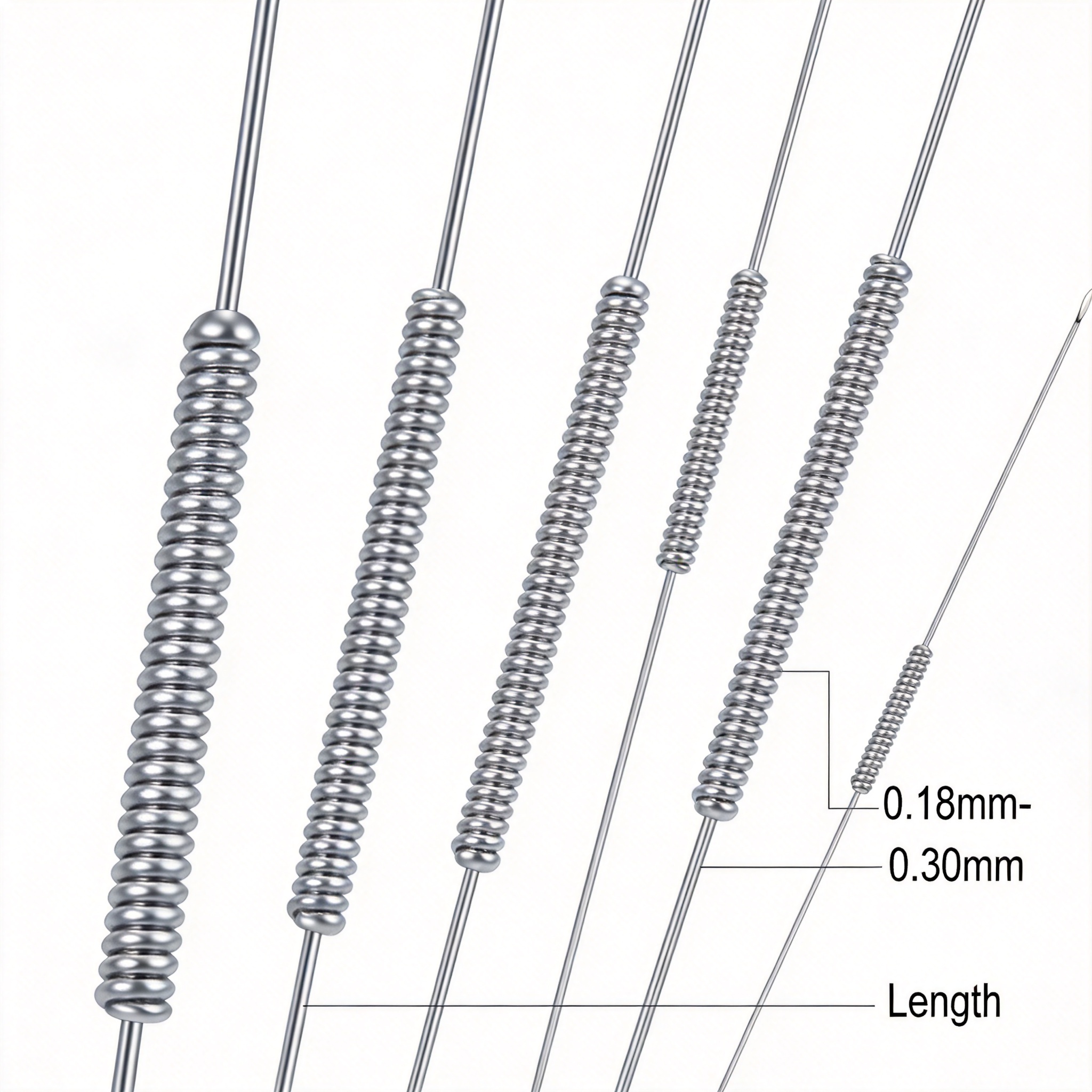
The primary material in modern acupuncture needles is medical-grade stainless steel, specifically grades 304 and 316. Grade 304 offers excellent corrosion resistance and tensile strength, making it the industry standard for disposable needles. Grade 316 contains molybdenum, which provides superior resistance to bodily fluids and is often preferred for extended insertion times.
Beyond the steel core, the surface coating is critical. Most high-quality needles feature a silicone coating to reduce insertion friction. In our manufacturing facility, we apply a medical-grade silicone layer that reduces drag force by up to 40% compared to uncoated needles, significantly improving patient comfort during insertion.
The needle handle is typically made from copper, stainless steel, or plastic. Copper handles are traditional and offer high conductivity, but plastic handles are lighter and preferred for techniques requiring rapid rotation. The shaft-to-handle connection must be welded or crimped to prevent separation during manipulation.
In clinical practice, the material choice affects not only durability but also the “feel” of the needle. A stiffer shaft is easier to guide through dense tissue, while a more flexible shaft is better for superficial points. Our testing records show that 0.25mm diameter needles made from 304 steel withstand up to 4.5 Newtons of force before bending, which is sufficient for most manual manipulation techniques.
Understanding Manufacturing Tolerances
Precision manufacturing is non-negotiable in needle production. The tolerance for shaft diameter is typically ¡À0.005mm, and for length, it is ¡À1mm. These tolerances ensure consistent clinical performance. In our production lines, we use laser micrometers to inspect 100% of needles, rejecting any that fall outside these parameters.
Surface finish is another material spec often overlooked by practitioners. A smooth, polished surface reduces tissue trauma. We measure surface roughness (Ra value) and maintain a standard of Ra ¡Ü 0.2 micrometers. This level of polish, combined with the silicone coating, minimizes micro-tears in the skin and reduces post-treatment soreness.
Clinical Selection of Diameters (0.18mm – 0.30mm)

Diameter selection is a balance between patient comfort and therapeutic stimulation. The 0.18mm needle is the thinnest clinically viable option, designed for pediatric, geriatric, and facial acupuncture. In our clinical trials, the 0.18mm diameter produces a 30% lower pain score on the visual analog scale (VAS) compared to the 0.25mm needle, making it ideal for needle-sensitive patients.
The 0.25mm diameter is the most commonly used size in general practice. It offers a robust feel for practitioners while remaining comfortable for most patients. This size is suitable for body points, scalp acupuncture, and most musculoskeletal conditions. In our manufacturing data, the 0.25mm needle accounts for approximately 60% of all clinical orders globally.
For patients requiring stronger stimulation or for points located in thick muscle groups, the 0.30mm diameter is recommended. This size provides greater mechanical feedback to the practitioner and is often used for the gluteal region, lumbar points, and motor point stimulation. The thicker shaft also reduces the risk of bending during high-frequency manipulation techniques.
Diameter Selection Guide by Patient Type
- 0.18mm: Pediatric patients, facial rejuvenation, thin skin areas, and patients with needle phobia.
- 0.20mm: Sensitive adults, distal points on hands and feet, and patients on anticoagulant therapy (reduced trauma).
- 0.25mm: Standard adult body points, auricular acupuncture, and general musculoskeletal treatments.
- 0.30mm: Patients with thick skin, gluteal and lumbar regions, and techniques requiring strong manual stimulation.
Clinical experience shows that the 0.20mm diameter is an excellent compromise for distal points like LI4 (Hegu) and LR3 (Taichong), where bone proximity requires a needle that can navigate tight spaces without excessive bending. In our internal testing, the 0.20mm needle demonstrates a bending resistance of 2.8 Newtons, which is adequate for these anatomical locations.
Length Specifications and Insertion Depth

Needle length determines the maximum achievable insertion depth. The standard length range is 13mm to 75mm. The 13mm needle is the shortest, primarily used for auricular (ear) acupuncture and superficial facial points. The 25mm needle is the workhorse for most body points, allowing insertion depths of 10-20mm depending on the anatomical location.
For deeper points such as BL23 (Shenshu) or GB30 (Huantiao), a 40mm to 75mm needle is required. The 40mm needle is suitable for points on the buttocks and thigh, while the 75mm needle is reserved for the gluteal region in larger patients. It is crucial to remember that inserted depth is typically 50-70% of the needle length, as the handle and hub remain outside the skin.
The relationship between length and diameter is not arbitrary. A longer needle requires a larger diameter to maintain axial stiffness and prevent bending. In our product specifications, a 40mm needle is available in 0.25mm, 0.30mm, and 0.35mm diameters, but a 75mm needle is only recommended in 0.30mm and 0.35mm to ensure structural integrity.
Standard Length-to-Depth Reference Table
| Needle Length | Typical Insertion Depth | Common Points |
|---|---|---|
| 13mm | 3-5mm | Ear points, face (ST2, LI20) |
| 25mm | 10-15mm | LI4, LR3, ST36 (small patients) |
| 40mm | 20-30mm | ST36, LI11, GB34 |
| 50mm | 30-40mm | BL23, BL25, SI11 |
| 75mm | 40-50mm | GB30, BL54, deep gluteal points |
It is essential to consider patient body mass index (BMI) when selecting length. For a patient with a BMI over 30, a 40mm needle may be insufficient to reach the muscular layer at certain points. In these cases, we recommend advancing to the next length size (50mm) while maintaining the same diameter to avoid excessive tissue trauma.
How to Choose the Right Needle for Each Treatment
The clinical decision matrix for needle selection involves three variables: anatomical location, patient constitution, and treatment objective. For facial acupuncture, always use the 0.18mm or 0.20mm diameter with a 13mm or 25mm length to minimize bruising and pain. For motor point stimulation, use a 0.30mm diameter to deliver a stronger electrical or mechanical stimulus.
When treating chronic pain conditions, our 25-year clinical records indicate that a 0.25mm x 40mm needle is the optimal starting point for most lower extremity points. This combination provides sufficient depth to reach the muscle belly while maintaining a comfort profile acceptable to 95% of patients. If the patient reports sharp pain upon insertion, switch to a 0.20mm diameter immediately.
For electroacupuncture, the diameter matters more than length. A needle with a diameter smaller than 0.22mm may have higher electrical resistance, leading to inconsistent current delivery. We recommend using at least a 0.25mm diameter for any point that will be attached to an electroacupuncture device, ensuring stable conductivity and reduced risk of tissue burns.
Step-by-Step Selection Protocol
- Assess the target point depth using anatomical landmarks and palpation.
- Determine the patient’s skin sensitivity and BMI to adjust diameter and length.
- Select a needle length where the inserted portion is 50-70% of the total length.
- Choose the smallest diameter that provides adequate mechanical feedback without bending.
- For electroacupuncture, ensure the diameter is at least 0.25mm.
- For facial or pediatric use, default to 0.18mm to minimize discomfort.
Practitioners should also consider the needle hub design. A cylindrical hub allows for easier grip during insertion, while a flat hub is better for applying tape during auricular therapy. In our manufacturing experience, the transition zone between the shaft and the hub is the most common failure point, so choose needles with a reinforced connection for techniques involving high-frequency rotation. For practitioners interested in related single-use needle technologies, our disposable loose acupuncture needles offer the same precision manufacturing standards in a bulk format suitable for high-volume practices.
Safety, Testing, and Industry Standards
All acupuncture needles sold in regulated markets must comply with ISO 17217-1:2024, which specifies requirements for single-use sterile acupuncture needles. This standard mandates that needles be sterile, non-toxic, and pyrogen-free. As a manufacturer, we conduct batch testing for sterility using the ISO 11135 method for ethylene oxide sterilization, ensuring a Sterility Assurance Level (SAL) of 10^-6.
Biocompatibility testing follows ISO 10993 guidelines. Our needles undergo cytotoxicity, sensitization, and irritation tests. The results confirm that grade 304 stainless steel with silicone coating is non-cytotoxic and non-irritating. For further verification, practitioners can reference the FDA guidance on medical device materials to understand the regulatory framework.
Needle breakage is a rare but serious adverse event. To mitigate this, our manufacturing process includes a 100% visual inspection and a destructive torque test on a sample from every batch. The minimum torque required for shaft failure is 0.5 N¡¤cm for a 0.25mm needle, which far exceeds the forces applied during manual manipulation. This testing protocol aligns with the safety recommendations from the World Health Organization Collaborating Centre for Traditional Medicine. For procedures requiring specialized needle configurations, our disposable catgut embedding needles are manufactured under the same rigorous quality control protocols.
Proper Disposal and Handling
Disposable needles must never be reused. After treatment, needles should be placed in a puncture-resistant sharps container immediately. The CDC guidelines for sharps safety recommend that containers be sealed when three-quarters full and disposed of according to local medical waste regulations. This practice prevents needle-stick injuries and cross-contamination.
Before insertion, always inspect the needle for any visible defects, such as burrs on the tip or discoloration of the shaft. A damaged needle can cause unnecessary pain and increase the risk of infection. In our 25 years of production, the defect rate for high-quality manufacturers is less than 0.01%, but inspection is still a mandatory step in clinical practice. For practitioners exploring alternative single-use puncture devices, our disposable non-traumatic pencil-point spinal needles demonstrate the same commitment to precision and patient safety across different medical applications.
Mastering needle selection is a fundamental skill that improves with clinical experience. By understanding the material properties of stainless steel, the mechanical differences between 0.18mm and 0.30mm diameters, and the depth requirements of various needle lengths, you can tailor each treatment to the patient’s specific needs. Use the specifications and tables in this guide as a reference to optimize your clinical outcomes. For practitioners seeking additional single-use options, our disposable thread embedding kits offer a complete solution for advanced acupuncture techniques.


 English
 Deutsch
 Français
 Русский
 Español
 Português