
Post-dural puncture headache (PDPH) remains one of the most common complications following spinal anesthesia and lumbar puncture. Although most cases are self-limiting, PDPH can significantly affect patient comfort, prolong hospitalization, and increase healthcare costs.
One of the most effective strategies for reducing PDPH is selecting the appropriate spinal needle. Among modern atraumatic designs, the pencil-point spinal needle has become the preferred choice for many anesthesiologists because it minimizes cerebrospinal fluid (CSF) leakage while maintaining excellent procedural performance.
Unlike conventional cutting needles, pencil-point spinal needles feature a rounded, non-cutting tip with a lateral opening that gently separates dural fibers rather than slicing through them. This innovative design helps preserve the natural structure of the dura mater, allowing the puncture site to close more effectively after needle withdrawal.
In this guide, we’ll explain how pencil-point spinal needles work, why they significantly reduce the risk of post-dural puncture headache, and what advantages they offer in modern clinical practice.
Why Does Post-Dural Puncture Headache Occur?
Post-dural puncture headache occurs when cerebrospinal fluid leaks through the puncture site created during spinal anesthesia or lumbar puncture. Continuous CSF leakage reduces intracranial pressure, producing the characteristic symptoms of PDPH.
Patients typically experience:
- Severe headache that worsens when sitting or standing
- Neck stiffness
- Nausea and vomiting
- Dizziness
- Visual disturbances
- Photophobia
Although several patient-related factors influence PDPH incidence, the design of the spinal needle remains one of the most important controllable variables.
Clinical Insight
Clinical studies consistently demonstrate that atraumatic pencil-point spinal needles significantly reduce the incidence of PDPH compared with conventional cutting-tip needles, particularly in obstetric anesthesia and young adult patients.
What Is a Pencil-Point Spinal Needle?
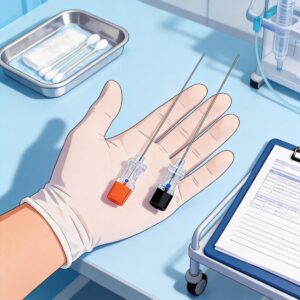
A pencil-point spinal needle is an atraumatic spinal needle designed to minimize tissue damage during dural puncture. Instead of using a sharp bevel to cut through tissue, it features a smooth rounded tip and a side-opening through which cerebrospinal fluid flows.
Common pencil-point needle designs include:
- Whitacre spinal needle
- Sprotte spinal needle
- Modified atraumatic spinal needle designs
These needles are widely used in spinal anesthesia, cesarean section, orthopedic surgery, urology, pain management, and diagnostic lumbar puncture procedures.
The primary objective of the pencil-point design is to preserve the collagen fiber architecture of the dura mater, allowing the puncture site to seal naturally after the procedure.
How Does the Pencil-Point Design Reduce PDPH Risk?
The superior clinical performance of pencil-point spinal needles is based on several engineering principles that work together to reduce cerebrospinal fluid leakage and improve tissue healing.
1. Separation Rather Than Cutting of Dural Fibers
The rounded pencil-point tip gently separates the collagen fibers of the dura mater instead of cutting them apart. Because the fibers remain largely intact, they naturally return toward their original position after the needle is withdrawn.
This preservation of tissue structure creates a much smaller functional opening than conventional cutting needles, greatly reducing cerebrospinal fluid leakage.
2. Smaller Effective Dural Opening
Although two spinal needles may share the same gauge, the shape of the needle tip has a significant influence on the size of the dural defect.
Cutting needles create a clean incision that remains open until tissue healing occurs. Pencil-point needles, however, produce a narrow opening that contracts almost immediately because the dural fibers remain connected.
3. Reduced Cerebrospinal Fluid Leakage
Since less cerebrospinal fluid escapes through the puncture site, intracranial pressure remains more stable after spinal anesthesia. This directly contributes to the lower incidence of post-dural puncture headache reported in numerous clinical studies.
4. Improved Natural Dural Closure
One of the greatest advantages of pencil-point spinal needles is their ability to promote natural closure of the dural puncture site. Because the collagen fibers are separated rather than severed, the dura mater can quickly return to its original position after needle withdrawal.
This natural tissue reapproximation minimizes the residual opening, allowing cerebrospinal fluid leakage to decrease rapidly. As a result, patients experience a significantly lower risk of developing post-dural puncture headache (PDPH).
5. Better Cerebrospinal Fluid Pressure Stability
Cerebrospinal fluid (CSF) maintains a delicate pressure balance within the central nervous system. Excessive CSF leakage following spinal puncture reduces intracranial pressure and is the primary mechanism responsible for PDPH.
By preserving the structural integrity of the dura mater, pencil-point spinal needles help maintain normal CSF pressure after spinal anesthesia, reducing headache severity and improving postoperative recovery.
6. Less Tissue Trauma During Needle Insertion
The smooth, rounded geometry of a pencil-point spinal needle requires less cutting force during insertion. Instead of creating sharp tissue damage, the atraumatic tip gently spreads tissue fibers apart.
This design minimizes:
- Mechanical tissue injury
- Inflammatory response
- Minor bleeding around the puncture site
- Patient discomfort during spinal anesthesia
Reduced tissue trauma also contributes to faster healing and improved patient satisfaction after neuraxial procedures.
Clinical Tip
For obstetric spinal anesthesia and cesarean section, many anesthesiologists prefer 25G or 27G pencil-point spinal needles. These smaller atraumatic needles have been shown to significantly reduce the incidence of post-dural puncture headache while still providing reliable cerebrospinal fluid flow for successful anesthesia.
Clinical Benefits of Pencil-Point Spinal Needles
The innovative atraumatic design offers several clinical advantages that benefit both healthcare professionals and patients.
Lower Risk of Post-Dural Puncture Headache
Clinical evidence consistently demonstrates that pencil-point spinal needles significantly reduce the incidence of PDPH compared with traditional cutting-tip spinal needles. Lower complication rates improve patient comfort while reducing the need for additional treatments such as epidural blood patches.
Improved Patient Recovery
Patients receiving spinal anesthesia with atraumatic needles generally experience fewer postoperative headaches, allowing earlier mobilization, shorter hospital stays, and improved overall satisfaction.
Higher First-Attempt Success
The rounded tip provides excellent tactile feedback during needle advancement. Experienced clinicians can more easily recognize changes in tissue resistance when passing through the ligamentum flavum and dura mater, improving first-pass success rates.
Enhanced Safety for High-Risk Patients
Pencil-point spinal needles are particularly valuable for patients who have a higher risk of developing PDPH, including:
- Obstetric patients
- Young adults
- Patients with low body mass index
- Patients undergoing elective orthopedic procedures
- Ambulatory surgery patients
Pencil-Point vs. Cutting-Tip Spinal Needles
Understanding the differences between atraumatic and conventional spinal needles helps clinicians select the most appropriate device for each procedure.
| Feature | Pencil-Point Needle | Cutting-Tip Needle |
|---|---|---|
| Tip Design | Rounded, atraumatic tip | Sharp cutting bevel |
| Dural Fiber Interaction | Separates collagen fibers | Cuts collagen fibers |
| CSF Leakage | Lower | Higher |
| PDPH Risk | Significantly Lower | Higher |
| Tissue Trauma | Minimal | Greater |
| Healing Response | Faster natural closure | Longer healing period |
| Typical Clinical Use | Spinal anesthesia, obstetrics, pain management | Selected diagnostic procedures |
For modern spinal anesthesia, many clinical guidelines recommend atraumatic pencil-point spinal needles whenever appropriate because they provide superior patient outcomes without compromising procedural success.
Engineering Advantages of Modern Pencil-Point Spinal Needles
In addition to their atraumatic tip geometry, modern pencil-point spinal needles incorporate precision manufacturing technologies that improve clinical performance and product consistency.
Optimized Tip Geometry
The rounded tip is carefully engineered to achieve an optimal balance between tissue penetration and fiber preservation. Precision grinding and polishing ensure consistent performance across every needle.
Smooth Surface Finish
Advanced polishing processes reduce surface friction, allowing smoother insertion and minimizing tissue resistance during spinal puncture.
High-Quality Medical Stainless Steel
Premium stainless steel provides excellent rigidity, corrosion resistance, and dimensional stability while maintaining the flexibility required for safe neuraxial procedures.
Excellent Biocompatibility
Medical-grade materials and strict manufacturing controls ensure reliable biocompatibility, making pencil-point spinal needles suitable for routine clinical use in hospitals and healthcare institutions worldwide.
Clinical Applications of Pencil-Point Spinal Needles
Thanks to their atraumatic design and excellent clinical performance, pencil-point spinal needles are widely used across multiple medical specialties. Their ability to reduce tissue injury and minimize cerebrospinal fluid leakage makes them the preferred choice for many neuraxial procedures.
Typical applications include:
- Spinal anesthesia for orthopedic surgery
- Cesarean section and obstetric anesthesia
- General surgery requiring neuraxial blockade
- Urology procedures
- Pain management interventions
- Diagnostic lumbar puncture
- Day surgery and ambulatory procedures
- Teaching hospitals and clinical training
Many healthcare institutions have transitioned from conventional cutting-tip spinal needles to atraumatic pencil-point designs as part of their patient safety and enhanced recovery protocols.
How to Select the Right Pencil-Point Spinal Needle
Selecting the appropriate spinal needle depends on the patient’s anatomy, the clinical procedure, and the physician’s experience. While smaller gauge needles generally reduce the incidence of post-dural puncture headache, they should also provide sufficient cerebrospinal fluid flow and reliable handling characteristics.
| Needle Gauge | Typical Application | Main Advantages |
|---|---|---|
| 22G | Diagnostic Lumbar Puncture | Faster CSF flow |
| 25G | Routine Spinal Anesthesia | Excellent balance of PDPH prevention and procedural efficiency |
| 27G | Obstetric & Day Surgery | Lowest PDPH incidence with excellent patient comfort |
Selection Tip
For routine spinal anesthesia, 25G pencil-point spinal needles provide an excellent balance between cerebrospinal fluid flow, ease of handling, and a low incidence of post-dural puncture headache. In obstetric anesthesia and ambulatory surgery, many clinicians prefer 27G needles when patient conditions and procedural requirements allow.
Why Choose Zhenjiang Gaoguan Medical Appliances Co., Ltd?
Zhenjiang Gaoguan Medical Appliances Co., Ltd specializes in the research, development, and manufacturing of high-quality disposable anesthesia products for hospitals, medical distributors, and healthcare brands worldwide.
Our spinal needles are manufactured using precision engineering, strict quality control systems, and high-grade medical stainless steel to ensure consistent clinical performance and patient safety.
- ✔ Professional manufacturer of spinal needles and epidural needles
- ✔ ISO 13485 certified quality management system
- ✔ CE certified medical devices
- ✔ OEM & ODM manufacturing services
- ✔ Advanced automated production lines
- ✔ Comprehensive quality inspection
- ✔ Stable global supply chain
- ✔ Export experience in multiple international markets
Whether you are a medical distributor, healthcare provider, or private-label brand, we are committed to delivering reliable anesthesia products that meet international quality standards.
Frequently Asked Questions
Why do pencil-point spinal needles reduce post-dural puncture headache?
The blunt, rounded tip separates rather than cuts dural fibers, allowing the puncture site to close naturally after needle removal. This significantly reduces cerebrospinal fluid leakage and lowers the incidence of post-dural puncture headache.
Are pencil-point spinal needles better than cutting-tip needles?
For most spinal anesthesia procedures, yes. Pencil-point needles generally produce less tissue trauma, lower PDPH incidence, and improved patient recovery while maintaining excellent clinical performance.
Which gauge is commonly used for spinal anesthesia?
Both 25G and 27G pencil-point spinal needles are widely used. The optimal gauge depends on patient characteristics, physician preference, and the specific clinical procedure.
Can pencil-point spinal needles be used for cesarean section?
Yes. They are commonly used in obstetric anesthesia because they significantly reduce the risk of post-dural puncture headache while providing effective spinal anesthesia.
Do pencil-point spinal needles reduce cerebrospinal fluid leakage?
Yes. Their atraumatic tip design minimizes the size of the dural opening and promotes faster natural closure, reducing cerebrospinal fluid leakage after spinal puncture.
What materials are used to manufacture pencil-point spinal needles?
Most high-quality pencil-point spinal needles are manufactured from medical-grade stainless steel with precision polishing to ensure smooth insertion, corrosion resistance, and excellent biocompatibility.
Are OEM and private-label manufacturing services available?
Yes. Zhenjiang Gaoguan Medical Appliances Co., Ltd offers OEM and ODM manufacturing solutions for spinal needles, epidural needles, and other disposable anesthesia products.
How can I choose the right spinal needle for my market?
Our engineering and sales teams can recommend suitable needle types, gauges, and packaging options based on your clinical requirements and market needs.
Looking for a Reliable Pencil-Point Spinal Needle Manufacturer?
Zhenjiang Gaoguan Medical Appliances Co., Ltd supplies high-quality disposable spinal needles, epidural needles, and anesthesia products to healthcare providers and distributors worldwide. We offer OEM & ODM manufacturing, strict quality control, and dependable global delivery.



 English
 Deutsch
 Français