
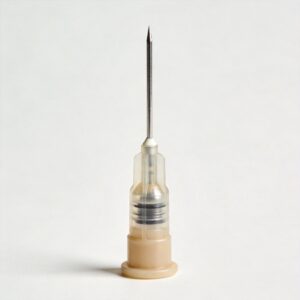
ISO 7864 is the international standard that specifies the requirements for sterile hypodermic needles for single use. It covers dimensions, needle tube and hub materials, sharpness, cleanliness, sterility, and packaging. A needle complies with ISO 7864 only when it passes the dimensional checks, the patency and rigidity tests, and the sterility assurance requirements defined in the standard. After reading this guide, you will be able to read a needle specification sheet, run the core verification checks, and identify the most common non-compliance mistakes.
Table of Contents
What ISO 7864 Covers and Why It Works

ISO 7864 belongs to the ISO 8537 family of needle standards and is maintained by ISO/TC 84, the technical committee for devices for administration of medicinal products. The standard exists because a needle is a precision interface: a fraction of a millimeter in the wrong place changes patient comfort, drug delivery, and safety. ISO 7864 locks down the geometry and performance so that a 21G needle from one manufacturer behaves predictably like a 21G needle from another.
The standard groups requirements into four areas: dimensions, mechanical performance, cleanliness and sterility, and packaging and labeling. Each area has its own test method, and each test produces a pass/fail result rather than a subjective judgment. That is what makes the standard usable in a quality system.
Dimensions and color coding
ISO 7864 references the color-coding system from ISO 6009, which assigns a color to each needle gauge so clinicians can identify sizes at a glance. The table below shows the gauges most commonly specified, with the nominal outer diameter and the color code.
| Gauge | Nominal outer diameter (mm) | Color code (ISO 6009) | Typical use |
|---|---|---|---|
| 18G | 1.2 | Pink | Blood donation, viscous fluids |
| 21G | 0.8 | Green | IM injections, blood draws |
| 23G | 0.6 | Blue | Subcutaneous injections |
| 25G | 0.5 | Orange | Pediatric, delicate veins |
| 27G | 0.4 | Grey | Intradermal, dental |
Beyond diameter, the standard controls needle length, the bevel angle, the hub dimensions (typically a 6% Luer taper per ISO 594), and the effective length from hub to tip. If any of these drift outside tolerance, the needle fails dimensional inspection even if it looks fine to the eye.
Mechanical performance requirements
ISO 7864 requires three mechanical tests. Patency confirms the lumen is open and allows free flow. Rigidity confirms the needle resists bending under a defined lateral load, so it does not flex during insertion. Sharpness confirms the tip penetrates a standardized medium within a specified force limit. A needle that is dimensionally perfect but blunt will still fail the standard.
Cleanliness, sterility, and packaging
Sterile hypodermic needles must be free from manufacturing residue and must be sterilized to a validated sterility assurance level (SAL) of 10^-6. The standard points to ISO 11135 (ethylene oxide), ISO 11137 (radiation), and ISO 17665 (moist heat) for sterilization validation. Packaging must maintain the sterile barrier until the point of use, and labeling must identify the gauge, length, lot number, and sterilization method.
How to Verify a Needle Against ISO 7864
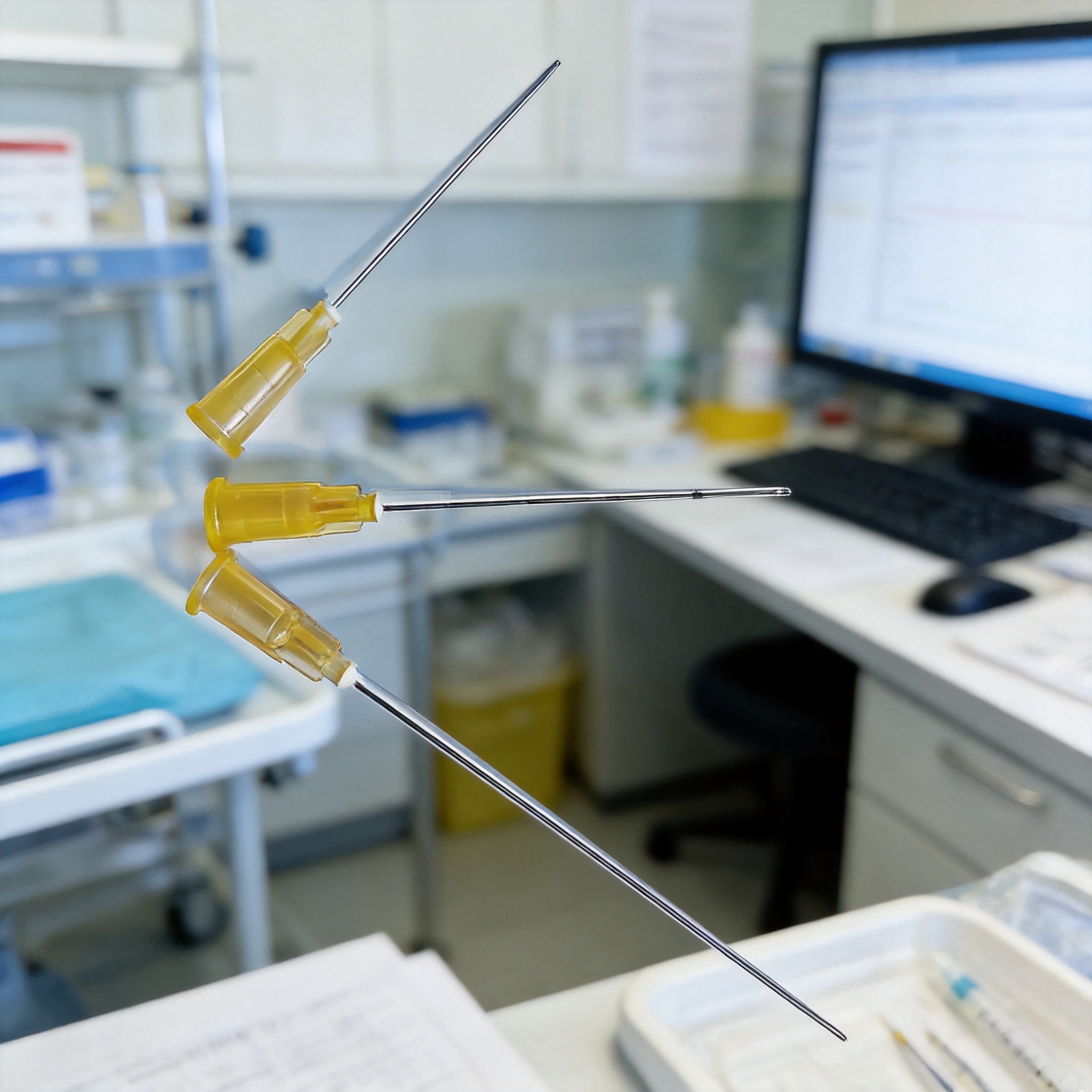
You can run a basic compliance check without a full laboratory. The steps below follow the order a quality technician would use, from the simplest visual check to the tests that need instruments. Each step produces a result you can record.
- Confirm the standard version on the label. Check that the packaging states “ISO 7864” and the year of the edition (for example, ISO 7864:2016). A needle labeled only “sterile” without a standard reference cannot be verified against ISO 7864.
- Verify the gauge and color code. Read the gauge printed on the hub or packaging, then confirm the hub color matches the ISO 6009 code for that gauge. A 23G needle must be blue. A mismatch is an immediate fail.
- Measure the outer diameter. Using a calibrated micrometer, measure the needle tube at three points along its length, avoiding the bevel. Compare the average to the nominal diameter for that gauge with the tolerance stated in the standard. Record each reading.
- Measure the effective length. Measure from the tip to the hub junction with a calibrated ruler or caliper. Compare against the labeled length. A 25 mm needle must measure within the tolerance band, not 24 mm or 26 mm.
- Check the hub fit. Attach the needle to a reference 6% Luer syringe or connector. It should seat firmly and hold pressure without leaking. A loose or cross-threaded hub fails the taper requirement.
- Run the patency check. Attach the needle to a syringe filled with water and push the plunger steadily. Flow should be smooth and continuous with no blockage. Record whether flow is free or restricted.
- Run the rigidity check. If you have a bending test fixture, apply the specified lateral load to the needle tube and confirm it returns to within the allowed deflection. Without a fixture, use the manufacturer’s test certificate as evidence.
- Run the sharpness check. Use the specified penetration test medium and force gauge. The tip must penetrate within the force limit defined in the standard. Record the peak force reading.
- Confirm sterility documentation. Request the sterilization validation report and the SAL statement. The report should reference ISO 11135, ISO 11137, or ISO 17665. Verify the lot number on the report matches the lot on the package.
- Inspect the sterile barrier. Check that the pouch or blister is sealed, undamaged, and shows no punctures or channel defects. A compromised barrier means the needle is no longer sterile regardless of the sterilization record.
If all ten steps pass, you have documented evidence that the needle meets the core ISO 7864 requirements. Store the readings and certificates together so the verification is reproducible during an audit.
Common Mistakes and How to Fix Them
Most failed audits trace back to a handful of repeatable errors. Each one has a clear symptom and a clear fix.
Mistake 1: Confusing “sterile” with “ISO 7864 compliant”
Symptom: The packaging says “sterile” and the needle looks correct, so it is accepted without checking the standard reference.
Fix: Sterility and dimensional compliance are separate requirements. A needle can be sterile but out of gauge tolerance. Always verify the ISO 7864 reference and the dimensional readings before accepting the lot.
Mistake 2: Measuring the diameter at the bevel
Symptom: Micrometer readings come back undersized and the lot is rejected, but the needle is actually fine.
Fix: The bevel tapers the tip, so a measurement taken near the point reads low. Measure the cylindrical tube body at least 5 mm back from the tip, at three points, and average the results.
Mistake 3: Skipping the patency and sharpness tests
Symptom: Dimensional checks pass, but clinicians report difficult injections or higher patient discomfort.
Fix: Dimensions alone do not prove performance. Add the patency flow check and the sharpness penetration test to your incoming inspection plan. A blunt tip passes every caliper check and still fails ISO 7864.
Mistake 4: Accepting a sterilization certificate without a lot match
Symptom: A valid sterilization report exists, but the lot number on the report does not match the shipped needles.
Fix: Treat a lot mismatch as a failed verification. The report proves that some needles were sterilized, not that your needles were. Require a lot-specific certificate before release.
Mistake 5: Ignoring packaging integrity
Symptom: Sterility records are perfect, but the pouch has a pinhole or a weak seal.
Fix: Inspect the sterile barrier before every use and during incoming inspection. A damaged barrier invalidates the sterility claim even when the sterilization process was validated.
FAQ
What is ISO 7864 in simple terms?
ISO 7864 is the rulebook for single-use sterile hypodermic needles. It defines how thick and long each gauge must be, how sharp and rigid the tip must be, how clean and sterile the needle must be, and how it must be packaged and labeled. If a needle meets ISO 7864, it meets a recognized international baseline for safety and performance.
Is ISO 7864 the same as ISO 8537?
No. ISO 8537 covers sterile single-use syringes, with or without needles. ISO 7864 covers the needle itself. A syringe-with-needle product may reference both standards, because the syringe and the needle each have their own requirements.
Does ISO 7864 require a specific sterilization method?
No. ISO 7864 requires that the needle be sterile at the stated SAL, but it does not mandate one method. It points to ISO 11135 for ethylene oxide, ISO 11137 for radiation, and ISO 17665 for moist heat. Any of these is acceptable if the process is validated and documented.
How do I know if a needle is ISO 7864 compliant?
Check three things: the packaging states the ISO 7864 reference, the gauge and color code match ISO 6009, and the manufacturer provides dimensional and sterilization test records for the specific lot. If all three are present and the readings fall within tolerance, the needle is compliant on the evidence available.
Can I verify ISO 7864 compliance without a lab?
You can verify dimensions, gauge, color code, hub fit, patency, and packaging integrity with basic calibrated tools. Rigidity and sharpness need a bending fixture and a force gauge, so for those two tests you rely on the manufacturer’s test certificate. That split is normal in incoming inspection.
For the authoritative text and current edition, consult the ISO 7864 standard page and the ISO/TC 84 committee page. For sterilization context in the United States, the FDA guidance on syringes and needles is a useful reference.
Disclosure: This guide describes the standard’s requirements and general verification methods. It is not a substitute for the purchased standard text or for accredited laboratory testing. No products or brands are endorsed.



 English
 Deutsch
 Français
 Русский
 Español
 Português