
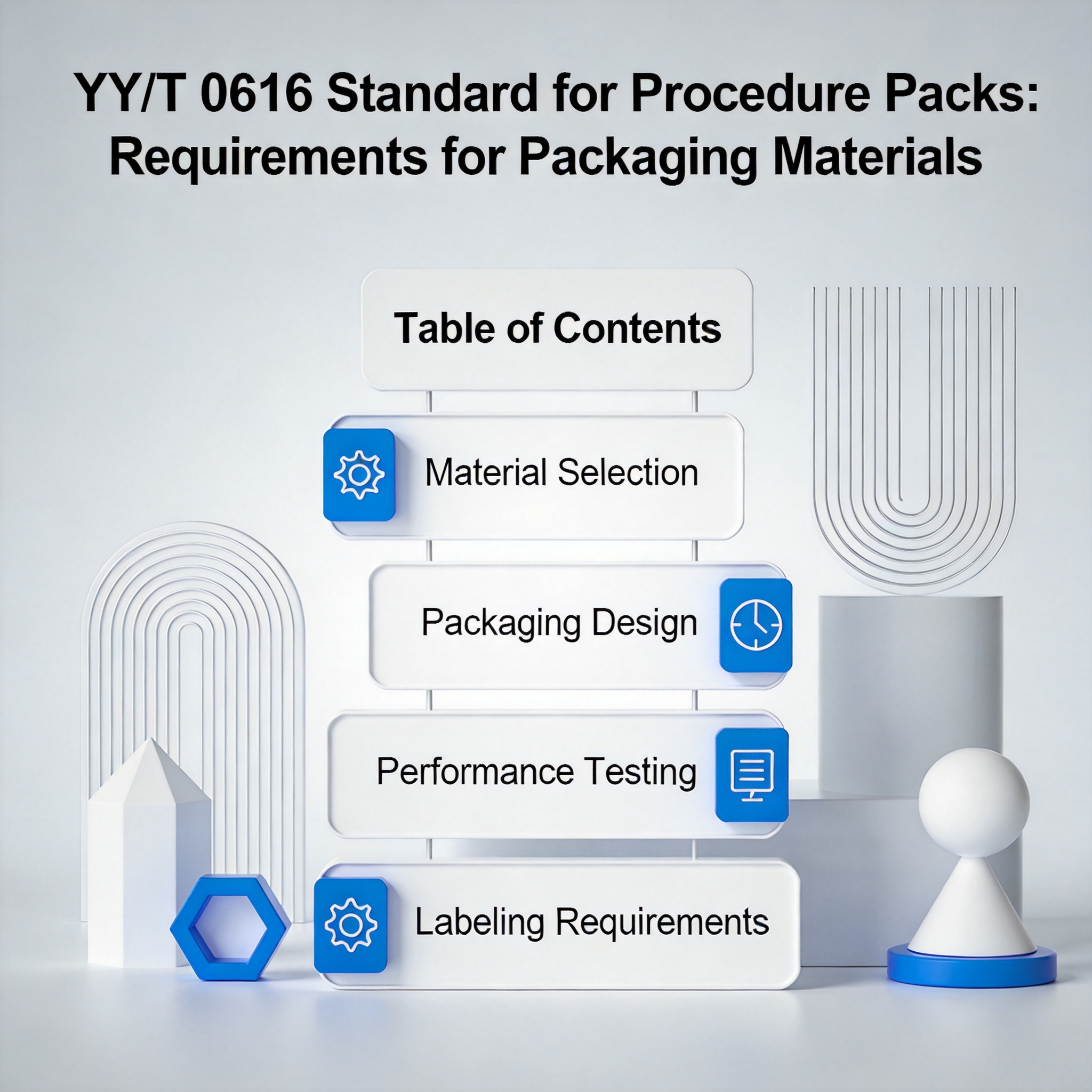
Table of Contents
1. Overview of YY/T 0616
In my 25 years as a medical device manufacturer specializing in sterile barrier systems, I have seen the evolution of Chinese regulatory standards first-hand. The YY/T 0616 standard is the critical benchmark for packaging materials used in procedure packs intended for single-use medical devices. It specifically addresses the requirements for materials used to manufacture sterile barrier systems, ensuring they maintain sterility until the point of use.
This standard is the Chinese equivalent to ISO 11607-1, and understanding its nuances is essential for any manufacturer exporting to or producing within China. It defines the performance requirements for materials, rather than prescribing specific material compositions. This allows for innovation while maintaining rigorous safety benchmarks for patient care.
For a manufacturer, compliance is not merely a regulatory hurdle; it is a patient safety obligation. The standard ensures that the packaging can withstand sterilization, transportation, and storage without compromising the sterility of the surgical instruments inside. I have seen facilities fail audits simply because they overlooked the specific preconditioning requirements for peel pouches.
1.1 Scope and Definitions
The scope of YY/T 0616 covers materials for packaging that are intended to maintain the sterility of medical devices. It applies to preformed sterile barrier systems, including pouches, reels, and rigid trays, as well as the materials used to form them. It is crucial to distinguish this from the packaging requirements for non-sterile devices, which fall under different regulatory guidelines.
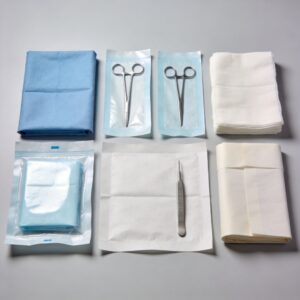
The standard defines a “procedure pack” as a collection of medical devices arranged for a specific clinical procedure. The packaging for these packs must be validated to ensure that the entire contents remain sterile. This requires a holistic view of the packaging process, from the raw material quality to the final sealed product. For instance, a disposable epidural anesthesia puncture kit must have its sterile barrier system validated to protect the patient from infection.
Key definitions include “sterile barrier system” (SBS) and “protective packaging.” The SBS is the minimum package that prevents microbial ingress, while protective packaging is designed to protect the SBS and its contents from physical damage. In my experience, engineers often confuse these two, leading to inadequate testing of the protective packaging in relation to the SBS.
2. Key Material Requirements
Under YY/T 0616, materials must be evaluated for their physical, chemical, and biological characteristics. The manufacturer must provide documented evidence that the material is safe for its intended use and compatible with the sterilization method. For example, materials used in ethylene oxide (EO) sterilization must demonstrate adequate permeability for gas penetration and aeration.
I recall a case in 2018 where a manufacturer used a high-density polyethylene film that was structurally sound but failed the microbial barrier test due to pinholes formed during flexing. The YY/T 0616 standard requires materials to pass a flex durability test that simulates the rigors of distribution. This test is non-negotiable for flexible packaging materials.
Chemical testing is equally critical. Materials must not contain substances that could leach into the device or cause toxicity to the patient. We typically request a biocompatibility report per ISO 10993-1 to satisfy the biological safety requirements referenced in YY/T 0616. This includes tests for cytotoxicity, sensitization, and irritation.
2.1 Common Material Types
While the standard is material-agnostic, certain materials have become industry standards. These include medical-grade kraft paper, Tyvek (flash-spun high-density polyethylene), and multi-layer film laminates. Each material offers distinct benefits and challenges regarding sealability and sterilization compatibility.
- Medical Kraft Paper: Excellent for EO and steam sterilization, but requires careful control of basis weight and porosity.
- Tyvek: Provides a robust microbial barrier and high tear resistance, ideal for heavy instrument sets.
- PET/PE Laminates: Offer clarity for visual inspection and are commonly used for low-temperature sterilization methods like EO.
The selection process must involve a risk assessment. For instance, if the procedure pack contains sharp instruments, the material must have high puncture resistance. I always recommend a “Design of Experiments” (DOE) approach to match the material properties with the specific device characteristics. This is particularly relevant when packaging items like a disposable spinal anesthetic needle, which requires a robust barrier to prevent damage during transport.
3. Performance Testing Protocols
Once the material is selected, YY/T 0616 mandates a series of performance tests. These are not optional; they are the core evidence of compliance. The primary tests include seal strength, burst testing, and the aforementioned microbial barrier test. These tests must be performed on packaging that has been subjected to the worst-case sterilization conditions.
In our facility, we perform seal strength testing using a tensile tester with a 180-degree peel method. The acceptance criteria are defined in the standard but must also be backed by internal validation data. We have established a minimum peel force of 1.5 N/15mm based on our historical data, which guarantees a secure seal without making it impossible for the clinician to open.
The microbial barrier test, often conducted using a bacterial aerosol or immersion method, is the ultimate proof of the “sterile barrier” claim. It is a complex test that requires a microbiology lab with proper containment facilities. We send our samples to a third-party lab that is accredited to ISO 17025 to ensure the results are recognized by regulatory bodies.
3.1 Seal Integrity Testing
Seal integrity is arguably the most critical parameter for a procedure pack. YY/T 0616 requires that seals be strong enough to withstand handling but weak enough to peel without tearing the paper (in the case of paper-to-film pouches). The standard specifies test methods for evaluating the seal width and continuity.
We use a dye penetration test for porous materials and a burst test for rigid trays. The dye test involves applying a dye solution to the seal area and checking for migration through the seal channel. This is a pass/fail test that is highly effective in identifying channel leaks.
- Dye Penetration: Validates seal continuity on porous materials.
- Burst Testing: Measures the pressure required to rupture the package, indicating overall integrity.
- Visual Inspection: Detects gross defects such as wrinkles, blisters, or burns on the seal line.
It is vital to test seals at the “worst-case” seal jaw temperature and pressure settings. In one audit, I noticed a manufacturer only tested seals at optimal parameters, which gave them excellent results but did not reflect production variability. We reduced the seal temperature by 10 degrees Celsius and the seals still passed, but this margin of safety is what the standard demands. This is especially critical for kits containing multiple components, such as a disposable combined epidural and spinal anesthesia puncture kit, where each component must remain sterile.
4. Process Validation and Aging
Material testing is only half the battle; process validation is the other half. YY/T 0616 requires that the sealing process be validated to ensure it consistently produces seals that meet the material specifications. This involves Installation Qualification (IQ), Operational Qualification (OQ), and Performance Qualification (PQ).
In our OQ, we map the temperature distribution across the seal jaw to identify cold spots. We use a thermocouple system to record the actual temperature at multiple points on the sealing surface. This data is essential to define the acceptable operating range for the sealing equipment used on the production floor.
After process validation, we conduct shelf-life validation. The standard requires that the packaging maintain its integrity over the declared shelf life. While real-time aging is the gold standard, accelerated aging is permitted. We typically use a 55-degree Celsius chamber with 60% relative humidity to simulate 3 years of aging over a 3-month period.
4.1 Accelerated Aging Data
Accelerated aging is governed by the Arrhenius equation, which assumes that chemical reactions increase with temperature. However, it is crucial to note that this does not apply to all materials. For instance, some adhesives can degrade at high temperatures, giving false negative results for seal strength.
I had a project where the accelerated aging test showed a 30% drop in seal strength, which was alarming. However, real-time data at 12 months showed no such degradation. This discrepancy was traced to the adhesive’s sensitivity to the 55-degree temperature. We had to adjust our validation protocol to use a lower accelerated aging temperature to get accurate data.
- Real-Time Aging: The most accurate method but time-consuming (requires the full shelf life duration).
- Accelerated Aging: Faster but requires careful selection of temperature to avoid altering failure modes.
- Environmental Conditioning: Includes temperature and humidity cycling to simulate transport conditions.
It is imperative to test the packaging after aging, not just the material properties. This includes repeating the seal integrity tests and the microbial barrier test on the aged samples. The results must show that the packaging still meets the requirements at the end of its labeled shelf life. This is particularly important for products like a disposable nerve block anesthesia puncture kit, which may have a longer shelf life due to its complex assembly.
5. Implementation Strategy for Manufacturers
Implementing YY/T 0616 requires a cross-functional team. It is not just a quality assurance task; it involves engineering, procurement, and production. The first step is a gap analysis of your current packaging systems against the standard’s requirements. This will highlight areas where your documentation or testing is insufficient.
I recommend establishing a “Packaging Specification” document that defines all critical characteristics of the packaging materials. This document should include drawings, material grades, and acceptance criteria for incoming inspection. Without this, your supplier may send you “equivalent” materials that do not perform the same, leading to failed validations.
Supplier management is a critical component. The standard requires that you have a quality agreement with your packaging suppliers. We audit our suppliers annually to verify their processes are stable and that they comply with the material specifications we have agreed upon. A single change in the supplier’s resin formulation can have a massive impact on sealability.
5.1 Documentation and Audits
Documentation is the backbone of compliance. Your validation reports must be comprehensive, including the test methods, equipment used, raw data, and conclusions. In China, the National Medical Products Administration (NMPA) will scrutinize this documentation during a registration audit. Incomplete records are a common reason for delays in product approval.
To prepare for audits, we keep a “Validation Master Plan” that lists all equipment and processes that require validation. This plan is updated annually and reviewed during management review meetings. It ensures that no packaging line is running without a validated process.
Finally, consider the human factor. Operators must be trained on the importance of seal parameters and how to identify defects. We use visual aids and “golden samples” of good and bad seals on the production floor. This practical training reduces human error and ensures that the validated process is followed consistently. This is especially vital when packaging delicate items like a disposable epidural puncture needle, where operator handling can directly impact package integrity.



 English
 Deutsch
 Français