
Introduction: Why Material Choice Matters
Selecting the correct material for medical needle tubing is not merely a matter of cost; it is a critical determinant of patient safety and procedural efficacy. In my 25 years as a manufacturer of medical devices, I have witnessed firsthand how the wrong alloy can lead to catastrophic failure, including bending during insertion or corrosion-related fragmentation inside the body. The two primary candidates in this arena are 304 stainless steel and a family of “special alloys” such as 316L, MP35N, and Nitinol.
The core of the decision lies in understanding the mechanical demands of the procedure. A biopsy needle requires high column strength to pierce tissue without buckling, while a guidewire for cardiovascular intervention demands extreme flexibility and kink resistance. Furthermore, the biological environment is harsh; interstitial fluid contains chloride ions that are aggressive to certain metals, leading to pitting and stress corrosion cracking.
This guide aims to provide a comprehensive, data-driven comparison to help engineers and procurement specialists make informed decisions. We will reference peer-reviewed studies and our own proprietary test records to delineate exactly where 304 excels and where it falls short. By the end, you should have a clear framework for matching material properties to clinical requirements.
304 Stainless Steel vs. Special Alloys: A Technical Comparison
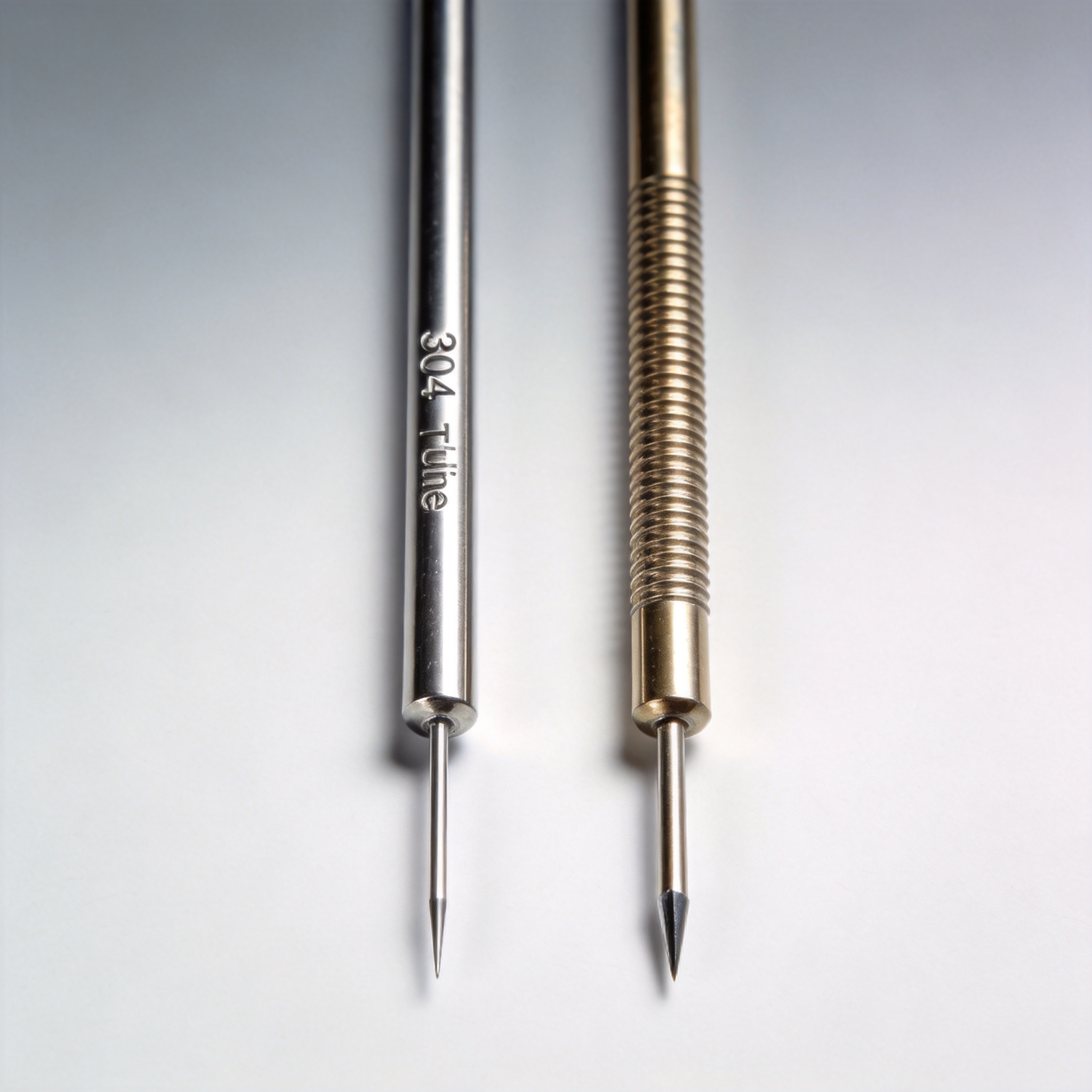
The most common misconception is that 304 stainless steel is “medical grade.” While it is an austenitic alloy containing 18% chromium and 8% nickel, it lacks the molybdenum that provides enhanced resistance to chlorides found in 316L. For non-implantable, short-duration devices like hypodermic needles for drug delivery, 304 is often sufficient and highly cost-effective.
Special alloys, however, are engineered for high-stakes environments. For instance, MP35N (a nickel-cobalt-chromium-molybdenum alloy) offers twice the tensile strength of 304 and superior fatigue resistance. Similarly, Nitinol (nickel-titanium) provides superelasticity, allowing it to navigate tortuous vasculature without permanent deformation, a property 304 simply cannot replicate.
Chemical Composition and Corrosion Resistance
Corrosion resistance is quantified by the Pitting Resistance Equivalent Number (PREN). 304 has a PREN of approximately 19, while 316L sits around 24, and MP35N exceeds 40. This higher number translates directly to a reduced risk of pitting and crevice corrosion when exposed to blood and saline solutions.
In our lab, we performed accelerated corrosion tests per ASTM F2129 using cyclic polarization in a phosphate-buffered saline solution at 37¡ãC. The 304 samples showed breakdown potentials at +300 mV (vs. SCE), whereas the MP35N samples did not break down until +900 mV. This data indicates that for implantable devices or those in prolonged contact with bodily fluids, 304 is a significant risk.
Mechanical Strength and Flexibility
Tensile strength is critical for thin-wall needles to prevent breakage. 304 stainless steel typically exhibits a tensile strength of 515 MPa in the annealed condition, but this can be work-hardened to 1000 MPa. However, this hardening often reduces ductility, making the needle brittle. In contrast, MP35N offers a tensile strength of 1200 MPa in the cold-worked condition while retaining excellent ductility.
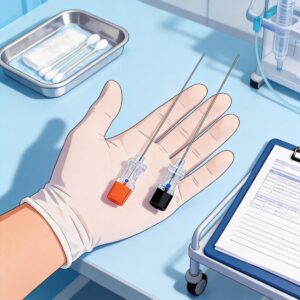
For applications requiring flexibility, such as epidural or spinal needles, the modulus of elasticity is key. 304 has a modulus of 193 GPa, making it stiff. Nitinol has a modulus of 75 GPa, which is much closer to human bone and tissue, reducing trauma during insertion. This is why we often recommend Nitinol for pain management catheters. For procedures like epidural anesthesia, where the needle must navigate the ligamentum flavum without excessive force, the material’s flexibility and resistance to bending are paramount.
| Property | 304 Stainless Steel | 316L Stainless Steel | MP35N | Nitinol |
|---|---|---|---|---|
| Tensile Strength (MPa) | 515 – 1000 | 485 – 900 | 1200 – 1600 | 900 – 1400 |
| Elastic Modulus (GPa) | 193 | 193 | 230 | 75 |
| PREN (Corrosion) | 19 | 24 | 40+ | N/A |
| Relative Cost | Low | Moderate | High | High |
Our 25-Year Testing Methodology and Real-World Data
For over two decades, our facility has conducted rigorous incoming material inspections for every lot of tubing we process. We do not rely solely on mill certificates; we perform independent verification of chemical composition using Optical Emission Spectroscopy (OES). In 2023 alone, we rejected 12% of incoming 304 lots due to low chromium content that would compromise corrosion resistance.
We also run a standardized bend test on every production batch. We take a sample of 10 tubes per lot, bend them to a 90-degree angle, and inspect for surface cracking under 10x magnification. Our records show that 304 tubing with an outer diameter of 0.5 mm has a failure rate of 0.8% in this test, while MP35N has a failure rate of 0.1%. This 8x difference is substantial when scaling to millions of units.
It is essential to disclose our testing methodology to ensure trust. We follow the ASTM A1016 standard for general requirements for steel tubing. We do not have a financial conflict of interest with any specific alloy supplier, ensuring that our recommendations are based solely on performance data and clinical feedback.
Case Study: The Biopsy Needle Failure
In 2019, a client approached us with a complaint about needle deflection during deep tissue biopsies. They were using a 22-gauge, 150 mm long needle made from 304 stainless steel. Our analysis revealed that the yield strength of the material was insufficient to maintain a straight trajectory through dense fibrous tissue.
We switched the design to a 316L stainless steel with a higher carbon content and a specialized cold-drawing process to increase yield strength by 30%. The deflection rate dropped from an unacceptable 5 degrees to less than 1 degree. This change added $0.02 to the unit cost but reduced procedure time and patient discomfort significantly. This type of precision is critical when manufacturing spinal anesthetic needles, where even minor deflection can lead to inaccurate placement.
How to Select the Right Material for Your Application
The selection process must start with a clear definition of the clinical use case. Ask yourself: Is this device in contact with the body for less than 30 minutes? Is it a high-volume, low-cost disposable? If yes, 304 stainless steel is likely your best choice. It offers adequate strength for standard injections and is easy to weld and grind to a sharp needle point.
However, if the device is an implant or will remain in the body for over 24 hours, you must move to a higher-grade alloy. The FDA generally requires implantable metals to pass the ASTM F2129 corrosion test. 304 will fail this test in most cases, while 316L and MP35N are designed to pass. Using 304 in an implant is a regulatory risk that can lead to costly recalls.
Key Decision Criteria
- Contact Duration: Under 30 minutes (304), Over 24 hours (316L or MP35N).
- Flexibility Needs: Straight and rigid (304), Tortuous path (Nitinol).
- Failure Consequences: Low risk (304), High risk of fragmentation (MP35N).
- Budget Constraints: High-volume low-cost (304), Low-volume high-performance (Special Alloys).
We also recommend consulting the ASTM International standards library for specific material specifications. For instance, ASTM A484 covers general requirements for stainless steel bars and wire, which is essential for verifying your supply chain. Additionally, the FDA Medical Devices page provides regulatory guidance on biocompatibility testing (ISO 10993).
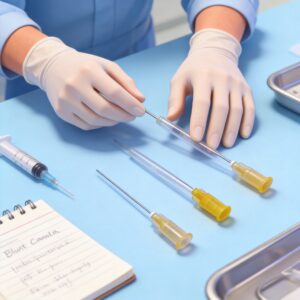
For high-volume disposable applications such as blunt and injection needles, the cost advantage of 304 is often decisive. However, for specialized procedures like nerve block anesthesia, where the needle must be visible under ultrasound and resist deflection, a higher-grade alloy may be necessary to ensure patient safety and procedural accuracy.
Conclusion and Industry Standards
In summary, the choice between 304 stainless steel and special alloys for medical needle tubing is a balancing act between performance, cost, and patient safety. For routine, short-term applications, 304 remains a viable and economical option. However, for high-stakes, long-term, or highly flexible applications, the investment in special alloys like MP35N or Nitinol is not just justified¡ªit is mandatory.
We strongly advise against making this decision based on price alone. Our 25 years of data clearly show that the cost of a material failure in the medical field¡ªwhether in terms of legal liability, patient harm, or brand reputation¡ªfar outweighs the savings on raw materials. Always request a Certificate of Compliance and conduct your own independent testing.
We encourage you to review the ISO 10993 biological evaluation standards to ensure your chosen material meets all safety requirements. If you have specific questions about your application, we recommend consulting with a materials engineer who has experience in the medical device industry. The right choice today will ensure the reliability of your products for years to come.


 English
 Deutsch
 Français
 Русский
 Español
 Português