
A non-electric infusion pump delivers a fixed flow rate using nothing but the elastic recoil of a pressurized reservoir. There is no battery, no programming, no alarm to silence and no pump to retrieve — the device is worn, delivers its volume at the rate the tubing was made to deliver it, and is discarded. For a patient who needs continuous local anesthetic infusion after surgery, or antibiotics at home, that simplicity is the feature.
This category covers elastomeric (non-electric) disposable infusion pumps: a pressurised elastomeric balloon reservoir, a flow-restricting tube that sets the rate, and a patient side with the connection the therapy requires. Common configurations deliver 100 ml or 200 ml over a fixed number of hours, with flow rates from 2 ml/h to 10 ml/h and bolus options for patient-controlled analgesia. Because the rate is set by the tubing geometry, there is nothing to mis-program — but it also means the rate must be chosen when ordering, not at the bedside.
The buyers of this category are usually comparing flow-rate accuracy across the infusion, not just at the start. An elastomeric device that delivers the first half faster than the second is not delivering the therapy that was prescribed.
Choosing between 100 ml and 200 ml, or between fixed-rate and bolus? Tell us the therapy, the duration and the delivery route. We will map the reservoir volume, flow rate and connector to the treatment — and send flow-curve data so you can see the accuracy rather than assume it.


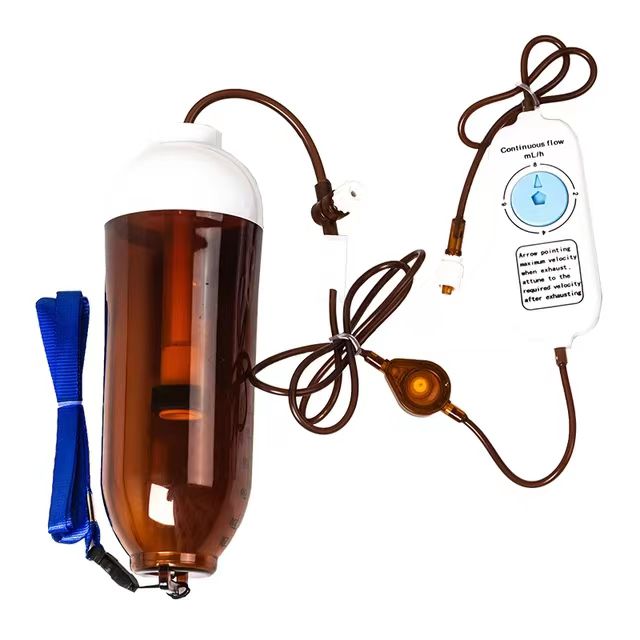
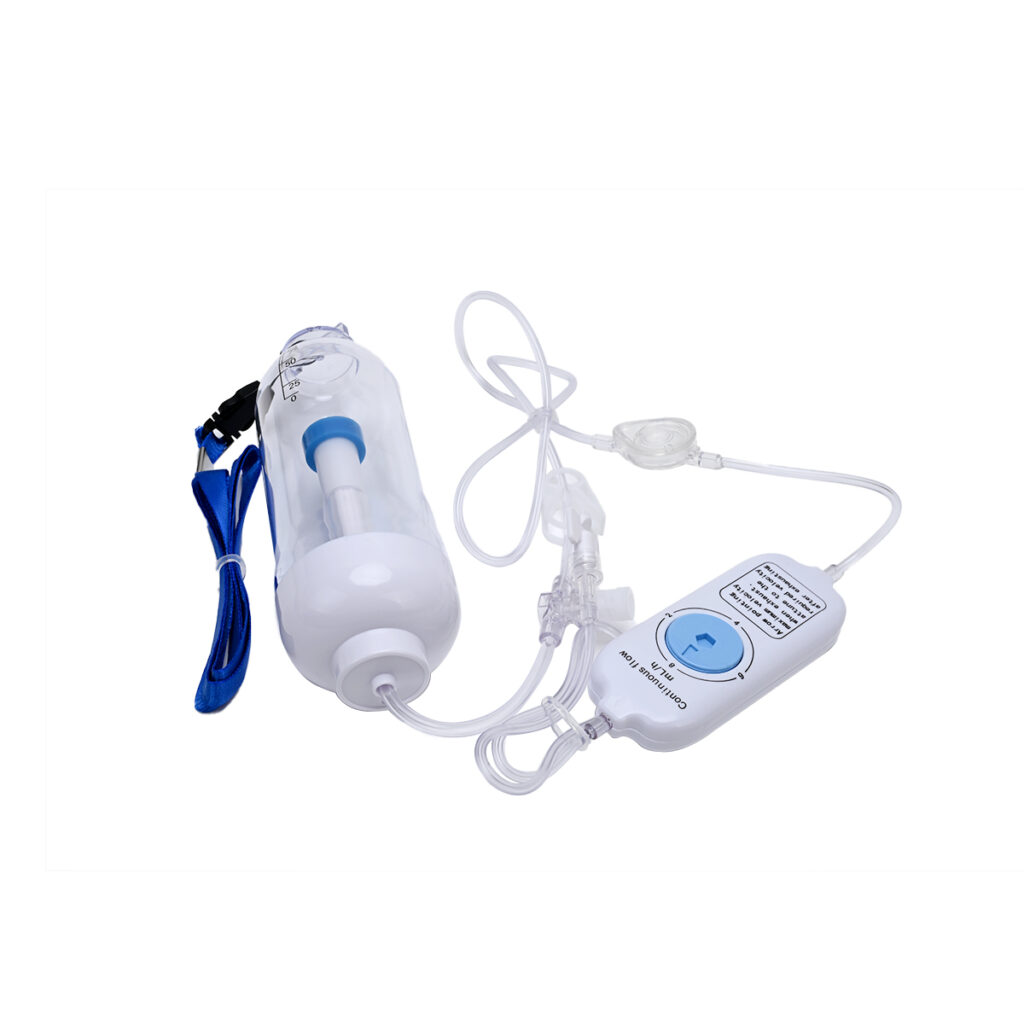
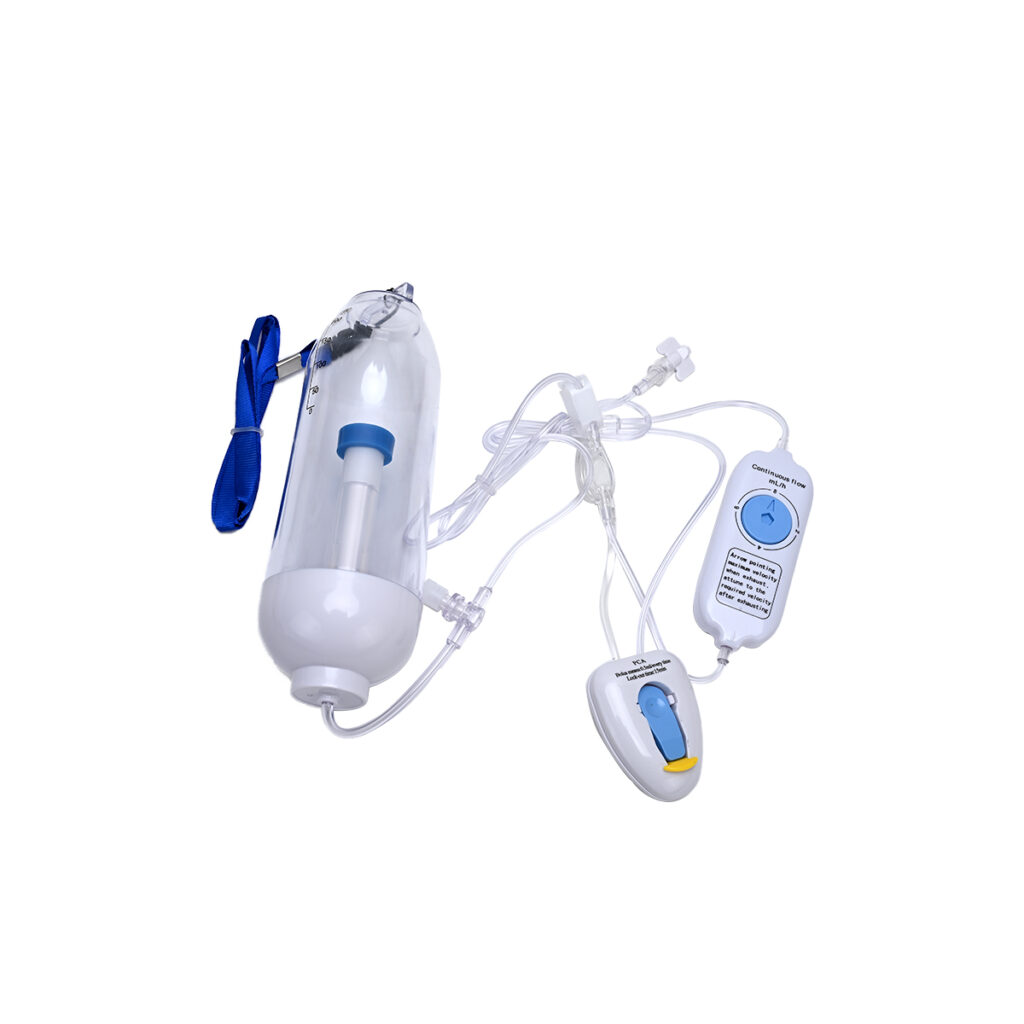
Four parameters define the order — three of them are fixed at manufacture:
| Parameter | Typical options | Effect |
|---|---|---|
| Reservoir volume | 100 ml / 200 ml | Sets total delivered volume |
| Flow rate | 2 / 5 / 10 ml/h | Sets infusion duration together with volume |
| Duration (typical) | 24 h / 48 h / 72 h | Result of volume divided by rate |
| Delivery mode | Fixed rate / bolus-capable | Continuous only, or patient-triggered dose |
| Patient connector | Luer, needle-free, catheter-specific | Must match the access device |
| Filling port | Standard fill port with cap | Pharmacy filling workflow |
Note: rate and volume are fixed at manufacture. Confirm the combination against the prescribed therapy before ordering — this is not a bedside-adjustable device.
For an elastomeric device the critical question is not "does it flow" but "does it flow at the stated rate, throughout":
Common rates are 2, 5 and 10 ml/h, and the rate is set by the flow-restricting tubing during manufacture — it cannot be adjusted at the bedside. Combined with a 100 ml or 200 ml reservoir, this gives durations of roughly 24, 48 or 72 hours. If your practice uses more than one rate, stock the rates you actually prescribe rather than substituting one for another.
No. On an elastomeric pump the flow rate is fixed by the geometry of the restrictor tube, so the rate is chosen when the device is ordered, not when it is filled or used. This is the trade-off for having no electronics to program or fail: the prescription has to be decided in advance. Devices are available in multiple rates to cover a mixed caseload.
Accuracy is specified both as a nominal rate and across the delivery curve, because elastomeric pressure falls as the reservoir empties and a poorly designed device under-delivers towards the end. We can provide flow-curve data for the configurations you are considering, so the accuracy claim can be checked against the full infusion rather than only the start.
A fixed-rate pump delivers a continuous preset flow only. A bolus-capable configuration adds a patient-triggered dose on top of the background infusion, which is used in patient-controlled analgesia where the patient manages breakthrough pain within a locked-out interval. The bolus feature changes the patient side of the device, so it is selected at ordering rather than added later.
It has to match the catheter your technique uses — which in peripheral nerve block is often a specific catheter connector rather than a plain Luer. This is the most frequent mismatch in ordering, and it is worth confirming against the catheter part number rather than assuming compatibility. We will confirm the pairing for your catheter if you send the specification.
Devices are supplied sterilized in individual packaging, ready for pharmacy filling in a clean environment according to your protocol. Sterilization method, shelf life and the fill-port format are stated on the label and supported by validation documentation available for your technical file.
Parent and related categories:
Anesthesia Consumables ·
Disposable Electronic Infusion Pump ·
Anesthesia Puncture Kit
OEM & manufacturing:
OEM Infusion Consumables ·
OEM & ODM Services ·
Low MOQ OEM
Regulatory guides for your market:
EU MDR Import Requirements ·
UK UKCA Registration ·
All Regulatory Guides
Who we supply:
Hospital Procurement ·
Homecare & Rehabilitation ·
Pain Management Clinics
Technical reading:
When to Use an Electronic Infusion Pump ·
Closed IV Infusion Standards ·
Catheter Materials Compared
Not sure which Disposable Portable Infusion Pump (Non-electric) specification matches your therapy?
Tell us the therapy, the duration you want and the catheter you use. We will map the volume, flow rate and connector, and send the flow-curve data so you can verify accuracy before ordering.
Flow-curve data is supplied with the quotation for the configuration you select.
 English English
 Deutsch
 Français
 Русский
 Español
 Português